
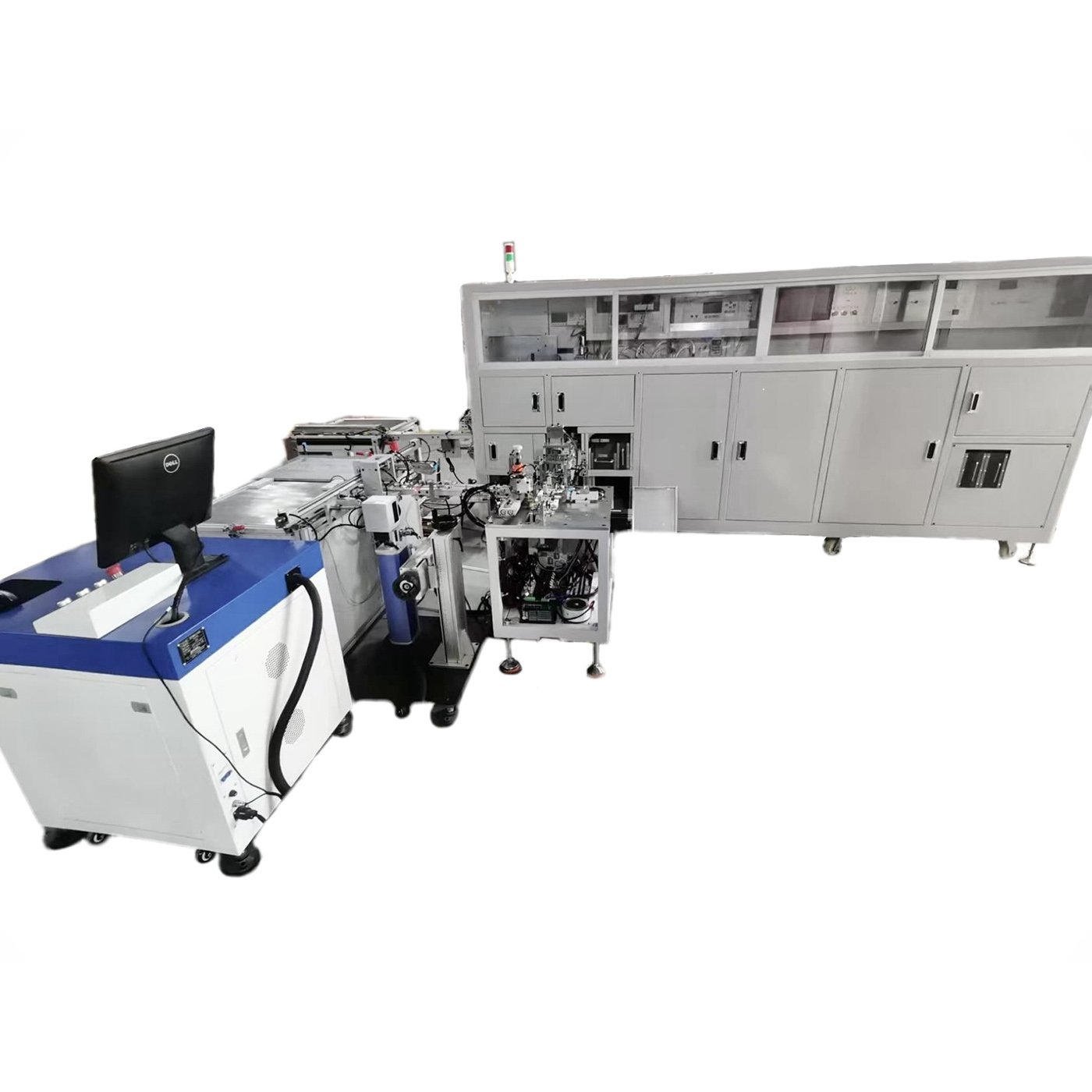
CX28026-X3 5-in-1 Test System (Foot Alignment, Trimming, Marking, and Tray Collection)
● It overcomes the phenomenon of inaccurate positioning and unstable feeding test caused by the wear and stretching of traditional chains over a long period of time.
-
The mechanical conveying part adopts synchronous belt transmission:
-
It overcomes the phenomenon of inaccurate positioning and unstable feeding test caused by the wear and stretching of traditional chains over a long period of time.
-
The transmission noise is small and the transmission is light.
-
It overcomes the phenomenon of dirt caused by chain oiling.
-
Feeding part: The cam manipulator handover method is adopted, and the feeding is accurate and stable, with a high feeding rate.
-
The feeding transmission has a foot calibration function, and the accuracy of the calibrated products on the fixture is high, stable and reliable.
-
Fixture part:
-
The fixture is carefully designed and has a reasonable structure. The tower spring and the clamping teeth are used to improve the clamping degree. The material is ABS.
-
The copper head of the entire fixture is designed on the side of the fixture, not directly above or below the fixture, to avoid copper powder falling into the fixture after wear, affecting the cleanliness and insulation of the fixture, and the fixture does not need to be cleaned.
-
The test piece directly contacts the product leads without an intermediate link. Advantages:
-
Low impedance, accurate and reliable test.
-
The four terminals directly contact the product leads, and can measure high frequencies, such as 100KHZ or higher.
-
The test end face has knurling treatment (the end face is concave and convex) to prevent the phenomenon of inaccurate impedance test caused by dirt generated by contact.
-
The test piece contacts the product position with high consistency, and the 100KHZ high-frequency test value is stable and reliable.
-
The machine transmission design adopts high-precision cam transmission, which is low noise, stable and reliable.
-
The normal operating speed of the machine is 100 pieces/minute.
-
In addition, our company's test machine has extended functions, such as:
-
Laser marking;
-
Needle calibration and foot cutting function;
-
Packaging and box arrangement function;
-
DVDT test function;
-
Low function consumption test function;
-
CCD appearance detection function;
-
ESR test.
-
Capacity, loss and insulation can all be set up by the touch screen, with functions such as data collection, capacity distribution diagram and data analysis.
The Electronic Component Test System is a key link to ensure the performance, reliability and security of electronic devices and systems. These systems test electronic components in terms of functionality, parameters, environmental adaptability and other aspects through various testing methods and equipment to ensure their stability and consistency in practical applications. The following is a detailed description of the Electronic Component Test System:
1. The basic concepts of Electronic Component Test System
The Electronic Component Test System is a collection of devices used to test the performance of electronic components, including resistors, capacitors, inductors, diodes, transistors, etc. These systems typically consist of manual testing tools and automated testing equipment, capable of providing high-precision measurement results and supporting multiple testing modes, such as resistance testing, capacitance testing, inductance testing, leakage current testing, etc.
2. Common Electronic Component Test System
Magnetic component testing system: It is used to test the performance of magnetic components (such as transformers and inductors) to ensure their stability and reliability under different working conditions.
– Capacitor testing system: It is used to test parameters such as the capacitance value, leakage current, and loss factor of capacitors to ensure their normal operation in the circuit.
Bias current test system: It is used to test the response characteristics of components under specific voltages or currents to ensure their performance in practical applications.
Component ATS (Automated Test System) : It is used for automating the testing of multiple electronic components to enhance testing efficiency and accuracy.
– LCR meter: It is used to measure inductance (L), capacitance (C) and resistance (R), and is widely applied in the testing and calibration of electronic components.
Ohmmeter: It is used to measure resistance values and is suitable for testing various electronic components, especially low-impedance components.
– Digital Storage Characteristic Curve graphician: It is used to draw and store the characteristic curves of electronic components, supporting multi-channel testing and data analysis.
3. Application of Electronic Component Test System
The Electronic Component Test System is widely applied in the production, research and development, and maintenance processes of electronic devices. For example:
Troubleshooting and verification in PCB and prototype design: Ensure the correctness and reliability of circuit design by testing the electrical parameters of components.
– Automotive electronic component testing: It is used to test the electromagnetic compatibility (EMC) of automotive electronic components to ensure their stability and safety in complex electromagnetic environments.
– Environmental testing: By simulating extreme temperatures, humidity, vibration and other conditions, the performance and lifespan of electronic components in different environments are evaluated.
4. Standards and specifications of the Electronic Component Test System
To ensure the accuracy and consistency of the Test results, the Electronic Component Test System must comply with international and industry standards. For example:
ISO/IEC 17025: It stipulates the general requirements for laboratories to ensure the calibration of testing equipment and the accuracy of testing methods.
– ANSI/ESD 20.20: It stipulates the requirements for anti-static protection to ensure that electronic components are not disturbed by static electricity during the testing process.
IEC 60068: It stipulates the rules for environmental testing to ensure the performance of electronic components under different environmental conditions.
5. The future development trend of Electronic Component Test System
With the continuous development of Electronic technology, the Electronic Component Test System is also constantly improving. The future development trends include:
– Automation and Intelligence: By introducing artificial intelligence and big data technologies, the automation level and testing efficiency of the testing system are enhanced.
– Integration and modularization: By integrating multiple testing functions, the volume and cost of testing equipment are reduced, and the flexibility and scalability of testing are enhanced.
– Green and environmental protection: By optimizing the design and materials of testing equipment, energy consumption and environmental impact are reduced, promoting sustainable development.
6. Challenges and Solutions of Electronic Component Test System
Although the Electronic Component Test System plays an important role in the electronics industry, it also faces some challenges, such as the high cost of test equipment, the complexity of the test process, and the issue of the accuracy of test results. To solve these problems, the following measures can be taken:
Introduce advanced testing technologies: such as using high-precision measuring equipment and automated testing systems to enhance the accuracy and efficiency of testing.
– Strengthen the training of testers: Through training and certification, enhance the professional skills and operational proficiency of testers to ensure the reliability of test results.
– Optimize the testing process: By optimizing the testing process and methods, reduce testing time and costs, and enhance the efficiency and economy of testing.
7. Summary
The Electronic Component Test System is an important guarantee for the safe and reliable operation of electronic devices and systems. Through various testing methods and equipment, these systems can ensure the performance and reliability of electronic components under different conditions. With the continuous development of technology, the Electronic Component Test System is also constantly improving, providing strong support for the high-quality development of the electronics industry.
Related products
-
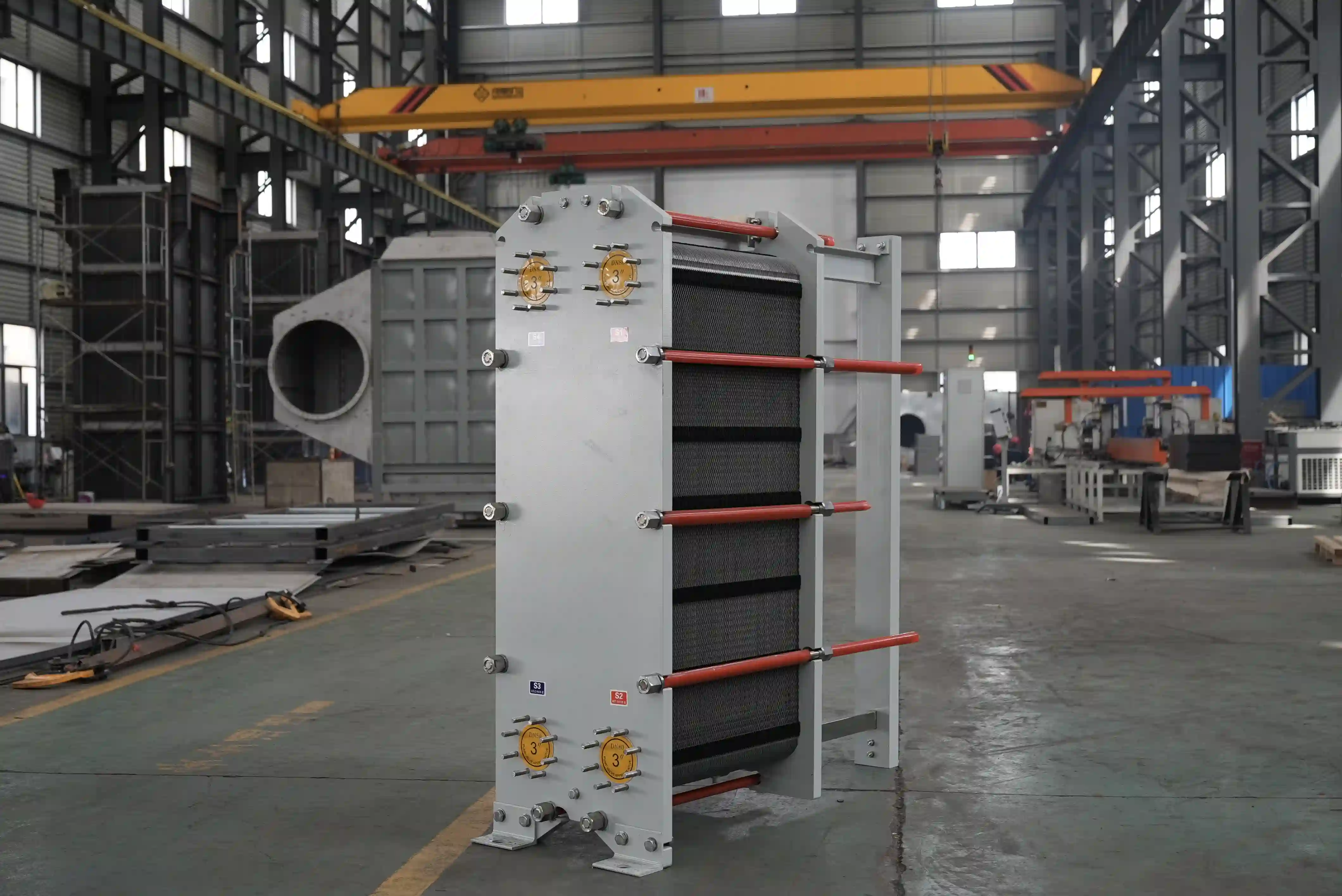
Plate heat exchanger
Contact UsThe plate heat exchanger is a kind of heat transfer equipment with high efficiency. Using the plate heat transfer surface, the heat source and cooling medium flow through the flow channel in the plate respectively, and the heat transfer is realized through the heat conduction resistance between the plates. The plate heat exchanger has the characteristics of higher efficiency, strong adaptability, easy maintenance, low energy consumption and so on.
Reviews
There are no reviews yet.