
Cartoning Machine vs Manual Packing: Why Automation Wins in Pharmaceutical Production
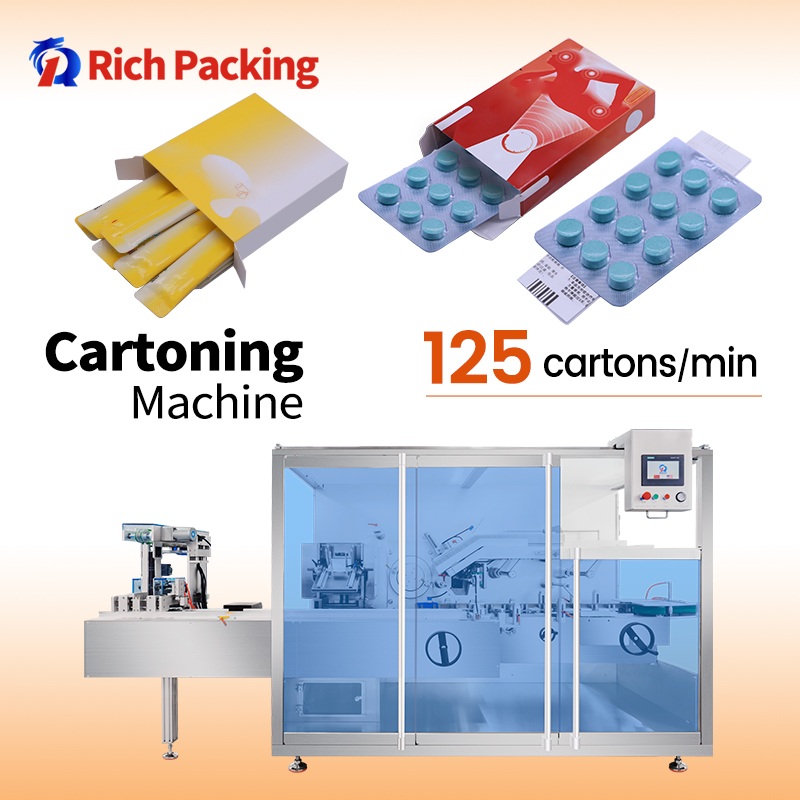
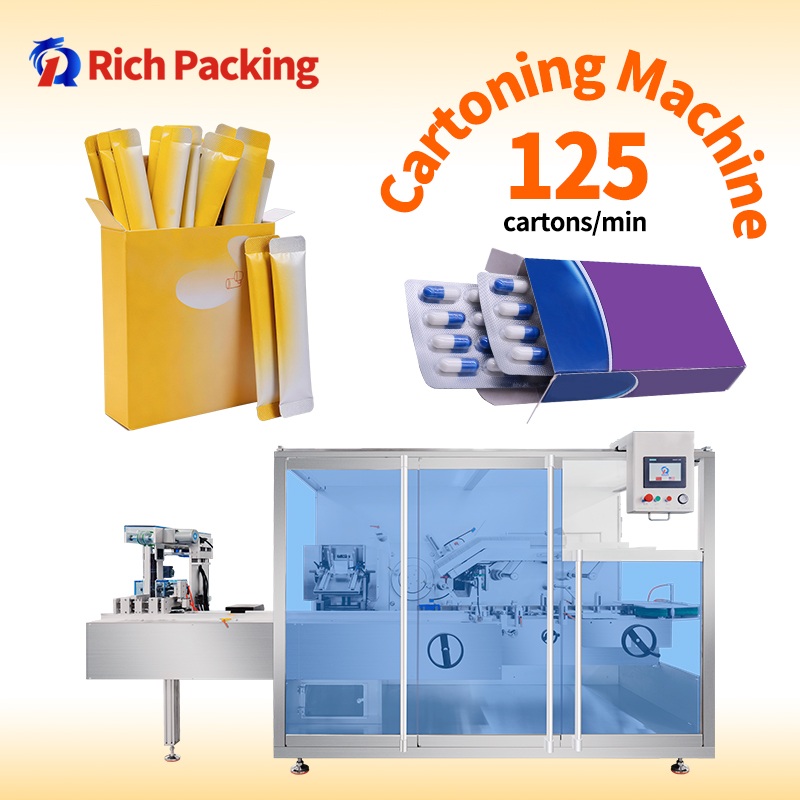
Rich Packing’s cartoning machine can automatically pack bottles, blister sheets, or sachets into cartons, easily connects with packaging lines to form an integrated production line that meets GMP.
In pharmaceutical and nutraceutical manufacturing, the debate between cartoning machines and manual packing represents a critical decision point that directly impacts production efficiency, cost control, and regulatory compliance. As global pharmaceutical standards tighten and production volumes increase, understanding the tangible advantages of automated cartoning solutions has become essential for manufacturers seeking competitive advantage.
Understanding the Two Approaches
Manual packing refers to the traditional process where human workers physically place bottles, blisters, or pouches into carton boxes, fold the cartons, and prepare them for shipment. This method requires minimal initial capital investment and offers flexibility for extremely small batch sizes or highly customized packaging requirements.
Cartoning machines, by contrast, are automated secondary packaging systems that mechanically pick, orient, insert, fold, and seal products into cartons at high speeds. Modern automated carton packers, including both horizontal and vertical configurations, integrate with upstream production lines to create seamless packaging workflows from primary packaging to final boxed product.
The Efficiency Gap: Quantifiable Performance Differences
The most striking difference between these approaches manifests in production throughput. While manual packing typically achieves 300-600 cartons per hour depending on worker skill and product complexity, automated cartoning systems routinely process 1,200-4,000 cartons hourly. This represents a 200-600% productivity increase that fundamentally transforms manufacturing economics.
In pharmaceutical environments where bottling lines operate at speeds of 4,000 bottles per hour—as demonstrated in implementations for U.S. pharmaceutical clients—manual packing creates immediate bottlenecks. Workers cannot sustain the pace required to match upstream automation, forcing manufacturers to either slow production lines or employ multiple packing stations with associated labor costs and coordination challenges.
Labor Cost Analysis and Long-Term Economics
Beyond raw speed, labor economics favor automation decisively. Manual packing requires continuous staffing across production shifts, with associated costs including wages, benefits, training, turnover replacement, and supervision. Pharmaceutical packing demands attention to detail and consistency, yet human fatigue inevitably introduces performance variability across shifts.
Automated cartoning systems require initial capital investment but deliver predictable per-unit costs that decrease with production volume. A single horizontal or vertical automated carton packer can replace 4-8 manual packing positions depending on line speed, with payback periods typically ranging from 12-24 months in medium to high-volume operations.
Accuracy and Regulatory Compliance Advantages
In pharmaceutical manufacturing, packaging accuracy directly impacts regulatory compliance and product liability. Manual processes introduce error risks including incorrect product-carton matching, missing package inserts, improperly closed cartons, and inconsistent labeling placement.
Automated cartoning machinery equipped with vision systems, barcode verification, and rejection mechanisms maintains 99.9%+ accuracy rates consistently. These systems verify product presence before carton closure, confirm correct orientation, and document every packaged unit—creating the audit trails demanded by cGMP and GMP standards without additional labor.
The integration capabilities of modern cartoning equipment prove particularly valuable. When combined with upstream counting systems that achieve 99.9% accuracy—as demonstrated in implementations for Kazakhstani pharmaceutical companies where accuracy improved from 87% to 99.98%—manufacturers create validated packaging chains that meet the strictest regulatory requirements.
Handling Diverse Product Formats
Product versatility represents another critical consideration. Manual packing handles format changes relatively easily—workers can pack different bottle sizes, blister configurations, or mixed products with minimal setup. However, this flexibility comes at the cost of slower processing and increased error rates during transitions.
Advanced automated carton packers address this challenge through modular design and quick-changeover mechanisms. Modern systems incorporate tool-less format changeovers, recipe-based parameter storage, and servo-driven adjustments that enable format switches in minutes rather than hours. This modular approach mirrors innovations in upstream equipment like capsule filling machines that achieve 14-minute mold changeovers—68% faster than industry averages—demonstrating how automation can deliver both speed and flexibility.
Quality Consistency and Brand Protection
Consumer-facing carton quality directly impacts brand perception, particularly in premium nutraceutical and pharmaceutical segments. Manual packing produces variable carton appearance with inconsistent flap folds, misaligned labels, and occasional damage from handling.
Automated cartoning delivers uniform presentation with precise folds, consistent glue application, and controlled insertion forces that protect product integrity. For fragile products like plant-based capsules—which in some manual operations experienced 16.3% loss rates before process optimization—the gentler, consistent handling of automation reduces breakage and material waste.
Scalability and Growth Planning
Manufacturing growth trajectories strongly favor automation. Manual packing scales linearly—doubling output requires approximately doubling staff with associated space, supervision, and coordination complexity. This creates practical limits on single-site capacity expansion.
Cartoning automation scales more efficiently. A single high-speed line can accommodate 200-300% production increases through speed adjustments and extended operating hours without proportional space or labor increases. For manufacturers serving global markets including North America, Europe, Middle East, and Southeast Asia, this scalability supports market expansion without repeated capital investments.
Integration with Complete Production Lines
Modern pharmaceutical manufacturing increasingly adopts integrated production line solutions that connect filling, counting, bottling, labeling, and cartoning into continuous workflows. Manual packing disrupts these workflows, creating inventory buffers, handling touchpoints, and coordination challenges.
Automated cartoning systems integrate seamlessly through conveyor connections, synchronized controls, and shared PLC control systems with HMI interfaces. This integration enables real-time production monitoring, automated line balancing, and rapid response to upstream disruptions—capabilities impossible with manual endpoints.
Implementations demonstrate this integration value. In cases where full-process high-speed capsule counting and bottling lines achieve 4,000 bottles per hour with integrated quality checks, automated cartoning completes the production chain without creating downstream constraints.
The Right Choice for Different Manufacturing Contexts
Despite automation’s advantages, manual packing retains relevance in specific contexts. For research laboratories, universities, or manufacturers producing fewer than 50,000 units annually with frequent format changes, manual packing’s low capital requirement and maximum flexibility may prove appropriate.
However, for pharmaceutical manufacturers, established nutraceutical brands, and operations exceeding 100,000 annual units, automated cartoning delivers measurable advantages in efficiency, accuracy, cost-per-unit, quality consistency, and regulatory compliance. The technology has matured to where even medium-scale operations benefit from automation.
Technical Support and Implementation Considerations
Successful automation requires proper implementation support. Leading pharmaceutical machinery manufacturers provide global on-site installation, commissioning services, and lifetime maintenance to ensure equipment performs to specification. With localized service centers in key markets and 3-year warranties backing equipment reliability, manufacturers can adopt automation confidently.
The 7-day rapid shipping available for standard cartoning models further reduces implementation timelines, enabling manufacturers to respond quickly to capacity constraints or market opportunities.
Conclusion: The Evolution Toward Automation
The cartoning machine versus manual packing comparison increasingly resolves in favor of automation for pharmaceutical and nutraceutical manufacturers. With 200-600% efficiency improvements, 99.9%+ accuracy rates, superior regulatory compliance, and favorable long-term economics, automated cartoning represents not merely an upgrade but a fundamental transformation in packaging capability.
As demonstrated through implementations serving Fortune 500 companies including GSK and UCB, and validated by manufacturers holding 43.6% market share in specialized machinery categories, automated cartoning technology has proven itself across diverse production environments and regulatory jurisdictions.
For manufacturers evaluating secondary packaging strategies, the question has shifted from whether to automate to when and how—making cartoning automation a central element of competitive pharmaceutical production strategy.
Related products
-
Double plus chains
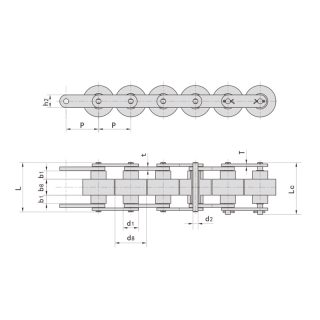
Contact UsDouble Plus Chains are a specific type of chain link structure that enhances the strength and durability of standard chains. They are often used in various applications, including construction, machinery, and heavy-duty securing. The ‘double plus’ designation indicates an additional layer of interlocking links, providing greater resistance to wear and tear.
Reviews
There are no reviews yet.