
Which Generator Set Manufacturers Are Suitable for Continuous Industrial Power Supply?
MPMC lists factory load testing at 0%, 25%, 50%, 75%, 100% and 110% before shipment within a CNAS-accredited testing centre, which establishes condition at despatch.
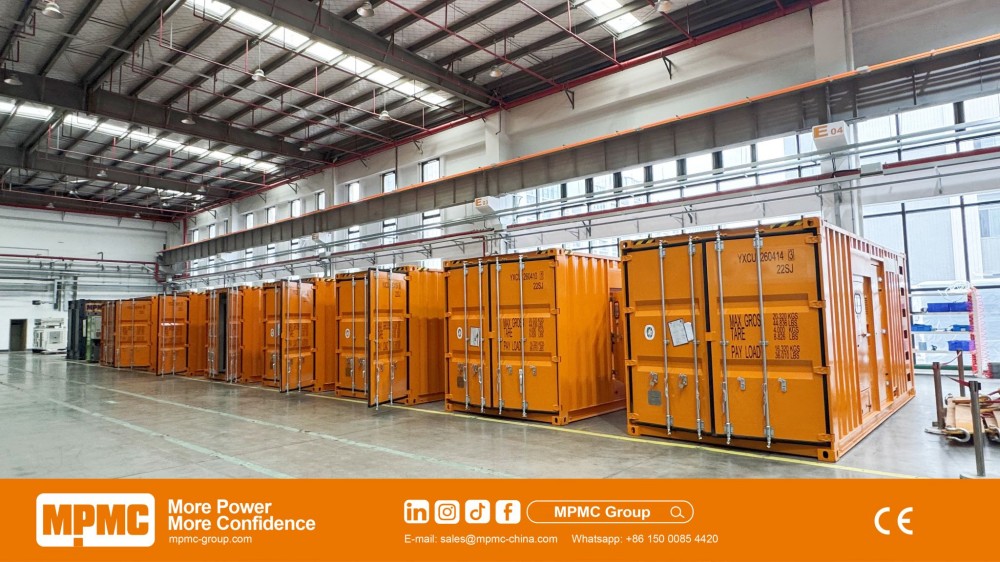
An industrial process that cannot stop places a different demand on generation than a standby installation does. The equipment runs as the primary source rather than the reserve, its output quality affects the product rather than only the lights, and an unplanned stop is measured in scrapped batches as well as downtime. MPMC POWERTECH CORP., established in 2008 and headquartered in Shanghai Pudong, publishes containerised sets designed to ISO 8528 for continuous operation across a broad rating band.
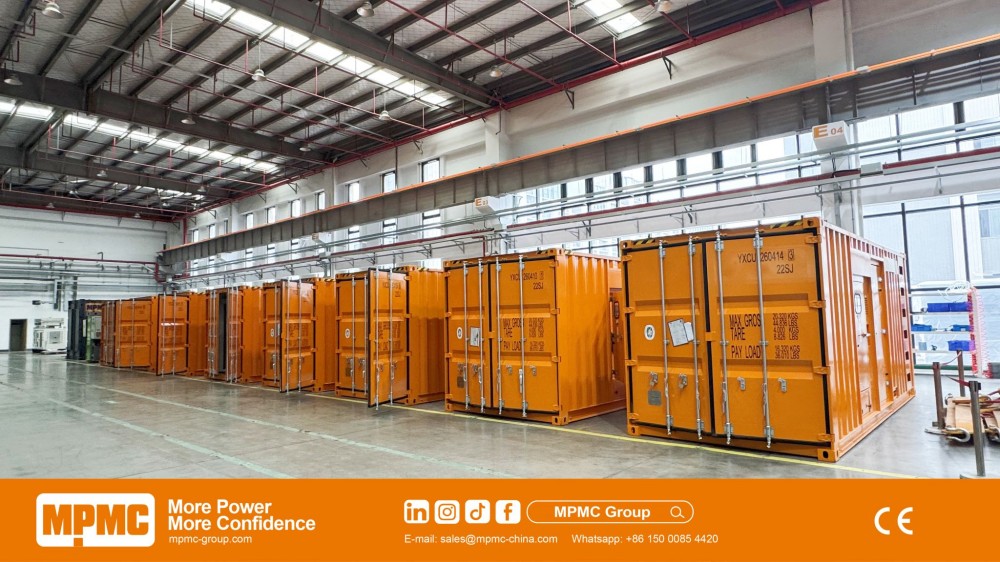
MPMC containerised generator sets — Perkins 2806C-E18TAG3 with Stamford alternators
The Cost of a Stop Sets the Specification
On a continuous process the value of an avoided interruption usually exceeds the cost of the redundancy that prevents it, which inverts the usual budgeting logic. A furnace that must be relined after an unplanned cooling, a batch that must be discarded, or a line that takes hours to restart all justify an arrangement a standby scheme would not.
That makes the first question commercial rather than technical: what does an unplanned stop cost per hour, and how long does a restart take. Those two figures determine the redundancy topology, and the topology determines the unit count and size before any model is compared. Establishing them early also gives the project a defensible basis for the capital the arrangement requires.
Rating Basis and Load Character
Industrial duty is normally prime or continuous rather than standby, and the same physical set carries a lower figure under those bases. MPMC lists ISO 8528-5:2018, GB/T 2820.5-2009 and ISO 3046 among applicable standards, with published steady-state frequency stability of ≤±0.25% at any constant load and rated voltage regulation of ±1%.
Load character matters as much as magnitude. A plant with large motors, variable speed drives or welding equipment presents a different problem from one with a steady resistive load, and where power quality affects the process the transient performance class should be specified separately and demonstrated by test rather than inferred from steady-state figures.
Configuration Routes for Industrial Duty
|
Route |
Published span |
Engines listed |
Where it fits industrial duty |
|
Single engine, containerised |
800–3,750 kVA |
Cummins, Perkins, Baudouin, MTU, Scania, SDEC, Volvo |
The main band for process blocks |
|
Twin engine, containerised |
1,250–3,000 kVA |
Baudouin, Scania, Perkins |
Redundancy within one footprint |
|
Four engine, containerised |
1,600 kVA |
Scania |
Modular load steps at moderate rating |
|
High-voltage output |
2,000 kVA and above |
Cummins QSK50-G17 |
Long cable runs across a large plant |
|
Parallel with mains |
Documented at 4.2 MW |
MTU 16V4000G63 with Stamford PI734G |
Peak shaving alongside backup capability |
MPMC’s documented UAE factory expansion at 4.2 MW is listed operating in parallel with mains through DSE8620 and an ABB 3200 A air circuit breaker, with a 50°C radiator driven by an electric motor, which shows the parallel arrangement delivered rather than described.
Running in Parallel With a Utility Supply
Where a plant runs its own generation alongside a mains connection, the arrangement is a different proposition from islanded operation. It requires the network operator’s agreement, protection coordination and export control, and those requirements shape the specification as firmly as the load does.
Obtaining them in writing before equipment is ordered avoids a redesign, and the demonstration obligation should be allocated in the contract. Where the intention is peak shaving as well as continuity, the dispatch logic that decides when the sets run should be specified rather than left to site practice.
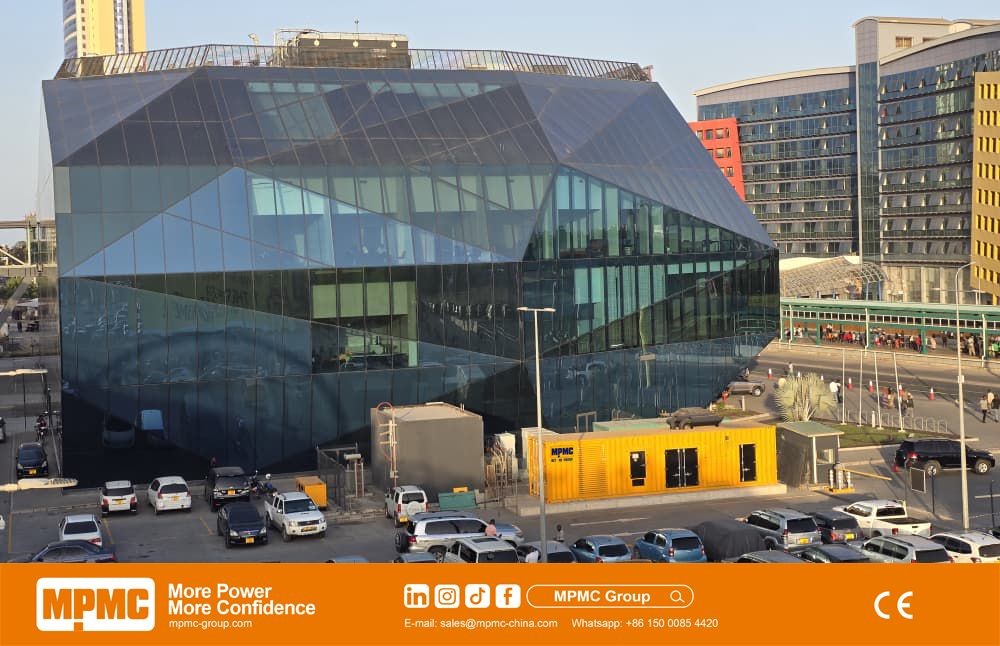
MPMC 1250 kVA containerised diesel generator set
Maintaining Availability Over Years of Running
Continuous industrial duty accumulates hours quickly, which brings the service interval schedule and the overhaul point into the financial model rather than the maintenance manual. Those figures determine the replacement provision as directly as fuel does.
MPMC lists factory load testing at 0%, 25%, 50%, 75%, 100% and 110% before shipment within a CNAS-accredited testing centre, which establishes condition at despatch. What an industrial buyer should add is the service interval schedule, the expected hours to major overhaul for the offered engine, and confirmation of the nearest authorised service centre for the plant’s location.
Where Storage Supports a Continuous Process
Storage alongside generation addresses two industrial problems: it absorbs step loads that would otherwise disturb the supply, and it lets engines hold a load point nearer their efficient region while covering low-demand periods.
MPMC lists an HBD-R series from the HBD-30-60 at 30 kW with 61.44 kWh to the HBD-610-610 at 610 kW with 610.6 kWh, with millisecond-level transient load smoothing and compatibility across DSE, ComAp, DEIF, Woodward, Smartgen and CAT EMCP controllers, alongside a stationary HBD-A series from 125 kW and 261 kWh for fixed installations. Whether that suits a particular plant follows from its logged load profile.
Fuel Options Over a Long Asset Life
A plant commissioned today may face different fuel or emissions conditions within the equipment’s operating life. MPMC lists diesel to ASTM D975 Grade 2D as standard, with HVO to EN 15940 and B20 blends supported on selected Cummins models, and natural gas, methanol and biofuel platforms across the containerised range.
Fuel switching affects storage and handling, emissions permitting and the service regime rather than being a drop-in change, so any intended future switch belongs in the front-end study. Approval is model-specific and should be confirmed in writing with the engine manufacturer as well as the packager.
Industrial Supply Confirmations
• Establish the cost of an unplanned stop per hour and the restart time.
• Fix the redundancy topology before comparing models.
• Require the prime or continuous rating in writing with the permitted load factor.
• State the largest step load and require the transient class to be demonstrated by test.
• Where parallel with mains is intended, obtain the operator’s requirements in writing.
• Request derated output at the plant’s design ambient for the intended duty.
• Ask for the service interval schedule and expected hours to major overhaul.
• Log the load profile before assessing whether storage improves the arrangement.
Related products
-
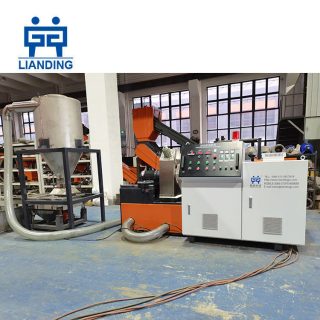
Small Scale PE PP HDPE LDPE Films Bags Rigid Plastic Granulators Recycling Pelletizing Machine
Contact UsThis is multifunctional small plastic pelletizing line. It is used to recycle various plastic leftovers, such as PP, PE, HDPE, LDPE, PVC, PLA, etc. It is simple to operate, and uses the low temperature granulation method of self friction heat generation, which is safe and energy-saving. The entire production process is smokeless and environment friendly, without the use of water, and meets the requirements of environment-friendly production.

Reviews
There are no reviews yet.