
How to Choose a Solar Controller Supplier in China: 12 Questions Before the Deposit (2026)
Most bad solar controller orders are not caused by bad products; they are caused by questions nobody asked before the deposit.
Published: November 2026 | By Kaichang Engineering Team
The cheapest way to avoid a bad controller order is to ask twelve specific questions before paying a deposit, and to insist on evidence rather than reassurance for five of them. Almost every dispute we hear about — certificates that do not cover the model shipped, firmware nobody can adjust, an app that dies with the supplier — traces back to a question that was never asked in the quotation phase.
Knowing how to choose a solar controller supplier from china is mostly knowing what a good answer sounds like. Below are the questions, the answer that should reassure you, and the answer that should end the conversation.
1. What are the twelve questions that actually change the outcome?
They fall into five groups: legal identity, certification, technical flexibility, commercial terms and after-sales. Two questions per group is enough to separate a factory from a trading office. That order is the practical answer to how to choose a solar controller supplier from china: start with identity, because every other answer is negotiable and that one is not.
• 1. Who owns the production line? Ask for the business licence, the factory address and the name on the proforma invoice. Good answer: all three match, and the factory address is not a floor of an office tower. Bad answer: "our factory is in another city, we handle sales here."
• 2. Does the CE certificate list your model? Ask for the test report, not the certificate. The report should name the standard (EN 61000-6-2 and 6-4 for EMC, EN 60335-1 for LVD), the laboratory, and your exact model in the annex. A certificate covering a different model number is decoration.
• 3. Which parameters can be changed in the field? Freeze protection start and stop temperature, differential, pump delay, maximum tank temperature. Good answer: a documented installer menu with ranges. Bad answer: "we can set it for you at the factory" — that means nobody can correct it on site.
• 4. Which sensors are supported? NTC10K B3950, PT1000, PT100, two-wire and three-wire. If the board only accepts the supplier's own probe, you are buying a consumable with every service call.
• 5. What is the relay rating — resistive or inductive? A 10 A/250 V relay driving a pump with a high inrush current needs derating; ask for the inductive figure and the number of operations. This is the single most common field failure on cheap boards.
• 6. What is the IP rating and is there conformal coating? Outdoor enclosures in humid or coastal markets need both. Ask for the coating specification, not the word "waterproof".
• 7. Which voltage variants exist, and at what MOQ? 220–240 V/50 Hz and 110–120 V/60 Hz are different boards, not a switch. MOQ per variant is usually higher than the headline MOQ.
• 8. What is the MOQ for a custom colour box and manual? Component MOQ and packaging MOQ are quoted separately, and packaging is often the larger number.
• 9. What is the lead time at 100, 500 and 2,000 units? Good answer: three different numbers with a stated reason. Bad answer: "25 days" for everything.
• 10. What can actually be customised? Logo method (silk screen or laser), enclosure colour, parameter defaults, manual language, firmware constants. Be suspicious of a supplier who says yes to all five without asking what your volumes are.
• 11. Whose cloud is behind the app? If the controller is Wi-Fi or 4G, ask who owns the server, whether it can be white-labelled, where the data sits and what happens to installed units if the relationship ends.
• 12. What spares will exist in year four? Boards, relays, sensors, valve heads. Good answer: a spare parts list with prices and an availability commitment. Bad answer: "we can always produce more" without a price.
✅ Bottom line: Ask all twelve, but demand documents for identity, certification, relay rating, MOQ per variant and spare parts — those five decide the order.
2. How do you verify the answers before paying anything?
Buy one sample, open it, and put the supplier on a video call with the board in front of the camera. One sample and one call cost less than a single wrong container, and they cover most of a solar water heater controller supplier vetting checklist before price is ever discussed.
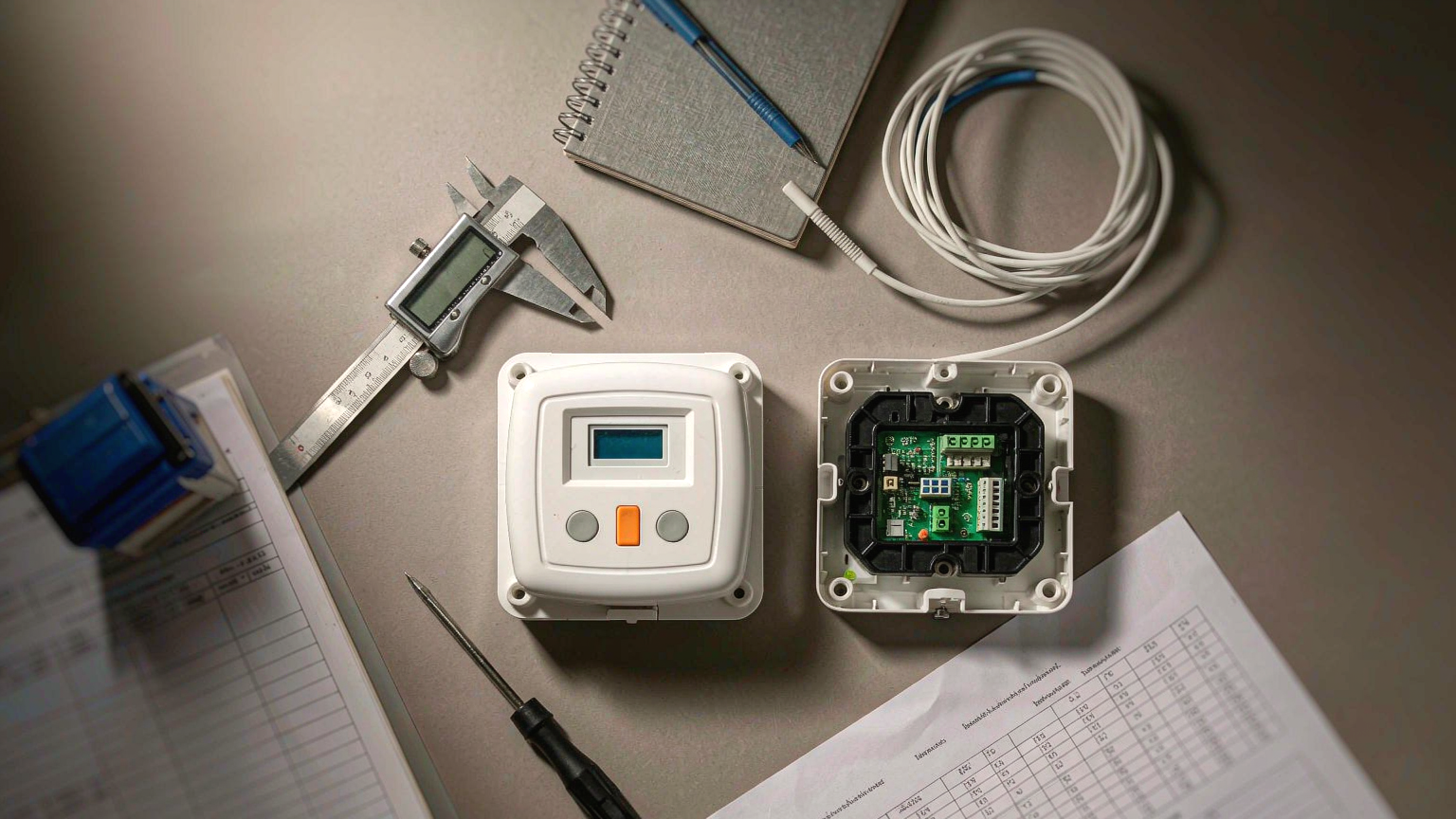
• Open the enclosure. Look for conformal coating, a relay with a recognisable brand and a rating printed on the body, a separate terminal block for mains and sensors, and a fuse on the mains side. A single-sided board with no fuse is a board designed to a price.
• Put it in the installer menu on camera. If the parameter list matches the manual you were sent, the firmware is documented. If the menu has three items and the manual has twenty, the manual belongs to a different product.
• Cross-check the certificate number. EMC and LVD reports carry a laboratory reference that can be verified with the issuing body. Ten minutes of checking beats a recall.
• Ask two reference customers in your region. Not logos on a website; names, countries and a contact who will answer one email about warranty handling.
Treat a solar water heater controller supplier vetting checklist as a scoring sheet rather than a pass-fail test. A supplier who fails one line can be managed; one who fails the certificate and the spares line cannot, because both surface in year two when you have no leverage. The questions to ask solar controller manufacturer before ordering are not adversarial — a good factory answers them faster than a trading office, simply because the answers exist in the building.
We publish our own answers to all twelve because they are easier to state than to fake. Kaichang runs its own production in Haiyan, Zhejiang, holds CE EMC and LVD reports issued in May 2023 with the KC-50 series named in the annex, and exposes freeze protection parameters in the installer menu rather than locking them. Kaichang also keeps board-level spares for OEM programmes, which is the answer most private-label buyers care about by their third order.
✅ Bottom line: Verify with a sample, a video call and two reference customers; documents beat promises every time.
Frequently asked questions
Q: Is it worth paying more to buy from a factory rather than a trading company?
A: Usually yes, but not for the reason buyers expect. The price difference is often 5–10%, while the difference in spare parts availability and parameter access is worth far more than that over five years. A good trading company with a real factory relationship can serve you well; the problem is that you cannot tell which kind you have without asking. The questions to ask solar controller manufacturer before ordering are exactly the ones a reseller cannot answer from memory.
Q: How do I compare how to choose a solar controller supplier from china options when three quotes look identical?
A: Compare the excluded items, not the price. Ask each supplier to state relay type, sensor compatibility, IP rating, warranty length, spare parts price list and MOQ per voltage variant on one page. The quotes stop looking identical immediately, and the cheapest one usually loses two or three lines.
Q: What is a realistic first order for a new distributor?
A: 100–300 units across two or three models, one voltage variant, standard packaging, and a written commitment on spares. That is enough to test field reliability without tying up capital, and it gives you a real basis for the second order. Kaichang quotes wholesale and custom ODM volumes separately so a first order is not priced as a container.
Ask us the twelve questions directly and we will answer in writing, including the two we would rather not: our relay derating figure and our spare parts price list. Haiyan Kaichang Energy Saving Electronics Co., Ltd. has manufactured solar water heater controllers and freeze-protection valves since 2015, holds four utility patents on drain and switching logic, and supplies OEM, ODM and wholesale customers from a single factory in Zhejiang. Send your model list and target market and we will return a quotation with the exclusions written down.
Related reading: solar water heater controllers · KC-50 series with CE EMC and LVD reports · request the twelve answers in writing
Related products
-
An ideal climate with Powerful units K48UXR-727P
Contact Us● Powerful units with high cooling and heating capacity
● Lightweight design, intelligent design
● Longer battery life, meeting the need for a full night’s sleep
● Energy saving/lightweight/quiet
● Split structure, bottom mounted
● Energy saving and low consumption, quality assurance
● The company has passed the automotive industry IATF16949 certification


Reviews
There are no reviews yet.