
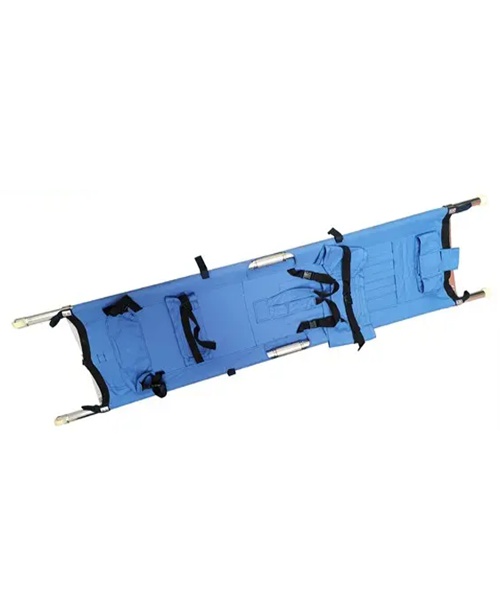
OEM Folding Stretchers Built for Extreme Rescue
OEM folding stretchers engineered for extreme rescue missions. Lightweight, durable, and fast-deploying for emergency, military, and disaster response use.
Emergency medical services and rescue operations face a persistent challenge: transporting casualties safely across unpredictable terrain while managing equipment that can withstand extreme conditions without burdening responders. When disaster strikes—whether in maritime environments, mountain rescues, or battlefield scenarios—the difference between equipment failure and mission success often hinges on a single piece of gear: the folding stretcher.
The Critical Engineering Challenge in Emergency Transport
Traditional stretchers present a fundamental design paradox. They must be lightweight enough for rapid deployment by fatigued rescue teams, yet robust enough to carry loads exceeding 250 kilograms across rough terrain without structural failure. Standard aluminum alloys used in many commercial stretchers—typically 6063 grade—offer adequate performance in controlled environments but demonstrate concerning failure rates when subjected to the repetitive stress of disaster zone operations.
The problem intensifies in specialized rescue scenarios. Maritime search and rescue teams confront saltwater corrosion that degrades metal components within months. Helicopter evacuation units require equipment compatible with hoist systems while maintaining structural integrity during high-altitude winching. Military medical units demand stretchers that fold into compact configurations for tactical transport yet deploy instantly under fire.
Material Science as the Foundation of Reliability
The solution begins at the molecular level. Advanced rescue stretcher systems now utilize 6061 aluminum alloy—a material specification that fundamentally changes performance parameters. Unlike the more common 6063 variant, 6061 alloy contains higher concentrations of magnesium and silicon, creating a crystalline structure with 40% greater tensile strength. This translates to a critical operational advantage: the stretcher frame bends under extreme stress rather than fracturing catastrophically.
DRAGON Stretcher Manufacturing Co., Ltd.(https://www.dragonmfc.com/), a China-based OEM specialist with over 20 years in emergency medical equipment production, has engineered folding stretchers with tube wall thicknesses 1-2 millimeters beyond industry standards. This seemingly minor specification change delivers measurable field performance improvements. In stress testing, these reinforced frames withstand loads up to 300 kilograms—accommodating bariatric patients or casualties with full tactical gear—while maintaining a folded footprint 60% smaller than rigid alternatives.
The fabric component presents equally complex engineering requirements. PVC vinyl fabric used in premium folding stretchers must satisfy multiple contradictory demands: tear resistance during dragging operations, waterproof integrity for decontamination protocols, fire resistance for industrial accident scenarios, and flexibility across temperature ranges from Arctic conditions to desert heat. The orange coloration serves dual purposes—high visibility in low-light disaster environments and compliance with international emergency equipment color standards.
Multi-Axis Folding Systems and Deployment Efficiency
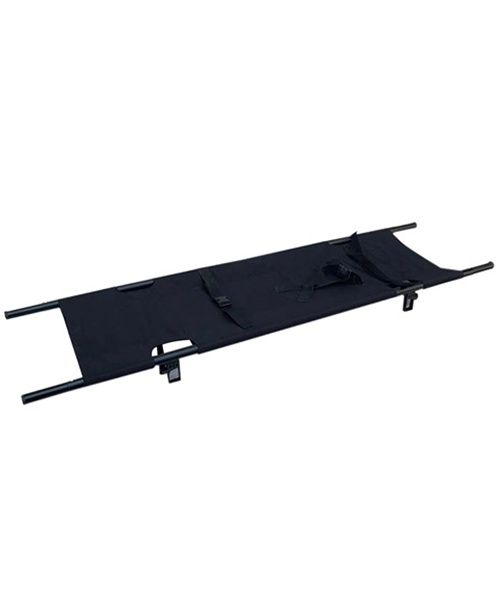
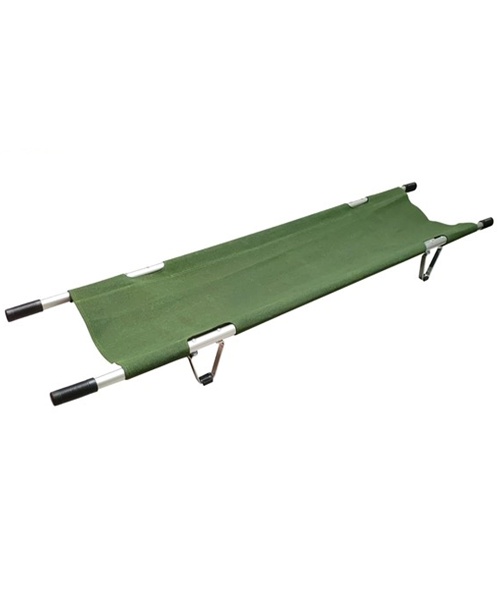
The folding mechanism itself represents a critical design decision that directly impacts operational readiness. Single-fold systems reduce length but leave width unchanged—problematic for helicopter storage. Multi-fold axis designs—incorporating double, triple, or quadruple folding points—allow stretchers to collapse into configurations as compact as 24 inches by 18 inches, fitting into rescue vehicle compartments alongside other essential equipment.
This compactness creates a strategic advantage in mass casualty incidents. A single rescue helicopter can carry eight quad-fold stretchers in the space previously occupied by three rigid models, tripling casualty evacuation capacity per sortie. For international aid organizations responding to earthquakes or floods, this storage efficiency directly correlates to lives saved during the critical first 72 hours.
Deployment speed presents the inverse challenge. Complex folding mechanisms that jam under stress or require multiple operators negate storage benefits. Advanced designs employ cam-lock hinges and spring-assisted deployment, enabling a single responder to transition the stretcher from storage configuration to operational readiness in under eight seconds—a specification validated in timed field trials with personnel wearing cold-weather gloves.
Specialized Environmental Adaptations
Maritime rescue operations expose equipment to one of the most corrosive environments on earth. Saltwater spray accelerates oxidation of aluminum components, while immersion scenarios demand waterproof integrity. High-performance folding stretchers designed for coast guard and naval applications incorporate several protective adaptations. Aluminum frames receive marine-grade anodization—an electrochemical process that creates a 25-micron oxide layer resistant to saltwater corrosion. Handle grips utilize non-slip rubber compounds that maintain friction when wet.
For air rescue scenarios, stretchers must interface with helicopter hoist systems while preventing entanglement with suspension cables during high-wind conditions. Specialized models feature integrated attachment points at head and foot positions, with reinforced stress distribution zones that prevent frame deformation when the stretcher is suspended vertically with a 250-kilogram load. The design allows rapid connection to carabiner systems without requiring responders to thread straps through the frame—a task nearly impossible in rotor wash conditions.
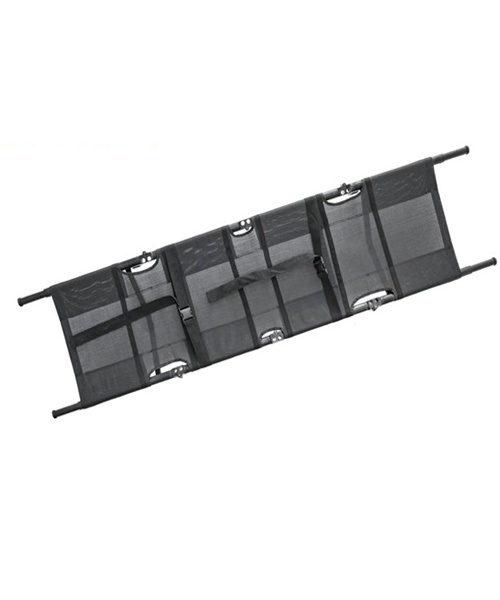
Military applications introduce additional constraints. Battlefield stretchers must function silently to avoid detection, resist damage from rough handling during tactical movement, and accommodate integration with body armor and combat helmets. The fabric component in military-grade models often incorporates breathable mesh panels that reduce patient heat stress during prolonged carries in hot climates, while maintaining blood and fluid impermeability for infection control.
Manufacturing Scale and Customization Capabilities
Large-scale emergency preparedness programs—whether government stockpiling initiatives or international humanitarian organization supply chains—require manufacturers capable of consistent quality across production runs numbering in the thousands. This demands both physical infrastructure and quality control systems that extend beyond typical medical equipment suppliers.
DRAGON operates a 500,000-square-meter production facility with dedicated stretcher manufacturing lines staffed by over 1,000 specialized technicians. This scale enables monthly production volumes exceeding 100 units for complex ambulance stretcher systems, with surge capacity for folding stretcher orders reaching several thousand units for emergency stockpile replenishment contracts.
The facility’s OEM and ODM capabilities address a persistent challenge in government procurement: standardization versus customization. National emergency management agencies often require stretchers compatible with existing vehicle mounting systems, incorporating specific color schemes for visibility protocols, or featuring logo placement that identifies equipment ownership across multi-agency response operations. Custom manufacturing services extend to drawing-based engineering—where procurement agencies provide dimensional specifications and attachment point requirements, and the manufacturer produces stretchers matching those exact parameters.
Validation Through Operational Deployment
Theoretical engineering specifications gain credibility through documented field performance. In maritime search and rescue operations, PE-based basket stretchers with integrated buoyancy systems have demonstrated zero equipment failure rates due to corrosion across multi-year deployments in saltwater environments. The buoyancy feature—achieved through optional inflatable floats—enables stable water-surface flotation, allowing rescue swimmers to secure casualties before helicopter extraction.
High-altitude helicopter evacuations in mountainous disaster zones have validated the performance of lightweight, suspension-compatible basket stretchers. These operations, conducted at altitudes exceeding 10,000 feet with significant rotor downwash, require equipment that maintains structural integrity during winching while allowing rapid patient immobilization. The 12-handle design common in advanced models provides multiple grip points for rescuers working on uneven terrain or within confined helicopter cargo spaces.
Military casualty transport operations have confirmed the field durability of customized 6061 aluminum alloy folding stretchers. Deployed across rugged, non-linear battlefield environments, these stretchers achieve rated load capacities of 250-300 kilograms while remaining lightweight enough for rapid tactical movement by two-person teams. The breathable mesh fabric reduces patient heat stress during prolonged evacuations in desert and tropical environments.
Economic Considerations and Lifecycle Management
Procurement decisions in emergency medical equipment involve balancing upfront costs against lifecycle value. Standard aluminum double-fold stretchers occupy the entry price point—approximately $2 to $15 per unit depending on specification—making them accessible for large-scale stockpiling by resource-constrained organizations. Custom multifunctional models with specialized materials and features command premium pricing, justified by extended operational lifespan and reduced replacement frequency.
Aluminum stretchers demonstrate service lives of 5-10 years under normal usage conditions, with proper maintenance extending operational periods significantly. Plastic stretcher variants, while offering corrosion immunity and lighter weight, typically require replacement after 3-5 years due to UV degradation and stress fracturing. This lifecycle differential factors into total cost of ownership calculations for procurement managers planning multi-decade equipment replacement schedules.
The Strategic Value of Specialized Manufacturing
Emergency rescue operations occur in the chaotic margins between preparation and catastrophe. Equipment failures in these environments don’t merely represent operational setbacks—they directly impact casualty survival rates. The folding stretcher, despite its apparent simplicity, embodies complex engineering tradeoffs between portability, durability, environmental resistance, and operational versatility.
Organizations tasked with emergency preparedness—whether national civil defense agencies, international humanitarian groups, or military medical units—increasingly recognize that stretcher procurement decisions carry strategic implications. Partnerships with OEM manufacturers possessing demonstrated production scale, material science expertise, and customization capabilities ensure that when disaster strikes, responders deploy with equipment engineered for the specific extremes they will encounter.
In an era where climate change intensifies natural disaster frequency and geopolitical instability expands conflict zones, the demand for reliable emergency medical transport equipment continues to grow. The manufacturers who combine two decades of specialized experience with modern production capacity—facilities exceeding half a million square meters, technical teams numbering over a thousand specialists—position themselves as essential partners in global emergency response infrastructure.
The folding stretcher remains what it has always been: a simple frame with fabric support. But when that frame is constructed from properly specified aluminum alloy, manufactured to tolerances that ensure multi-year durability, and designed through iterative feedback from actual rescue operations, it transforms into something far more significant—a tool that gives rescue teams one less variable to worry about when every second counts.
Reviews
There are no reviews yet.