


Switchgear Busbar Insulator: Dowe Electric’s UL94 V0 Rated Solutions
Switchgear Busbar Insulator: Dowe Electric’s UL94 V0 Rated Solutions
Industry Background: The Hidden Risks Behind Busbar Insulation
Modern electrical distribution systems—from low-voltage switchgear to 35KV substations—depend on a component that rarely draws attention until it fails: the switchgear busbar insulator. Industry data collected from field applications consistently points to a recurring set of pain points. Insufficient creepage distance can lead to short circuits. Inadequate high-temperature resistance compromises long-term reliability. Failure to meet UL94-V0 flame retardancy standards raises fire risk in enclosed cabinets. RoHS compliance issues can create regulatory exposure. Any one of these failures can translate into costly downtime and operational risk for manufacturers, power companies, and infrastructure operators alike.
This is precisely the gap that Yueqing City Dowe Electric Co., Ltd., operating under the DOWE and DUWAI brands, has spent over 14 years addressing. As a professional manufacturer of insulation components for low-, medium-, and high-voltage applications, the company’s technical accumulation offers a useful lens for understanding why busbar insulation deserves closer scrutiny from engineers, procurement teams, and safety auditors alike.
Authoritative Analysis: Why Insulation Performance Cannot Be an Afterthought
Necessity. Busbar insulators serve a dual function in switchgear systems: mechanical stabilization and electrical separation. In low-, medium-, and high-voltage distribution cabinets, standoff insulators must resist electromagnetic vibrations and thermal expansion that can otherwise generate mechanical stress or short circuits. Given that switchgear operates continuously under load, any degradation in mechanical or dielectric performance compounds over time.
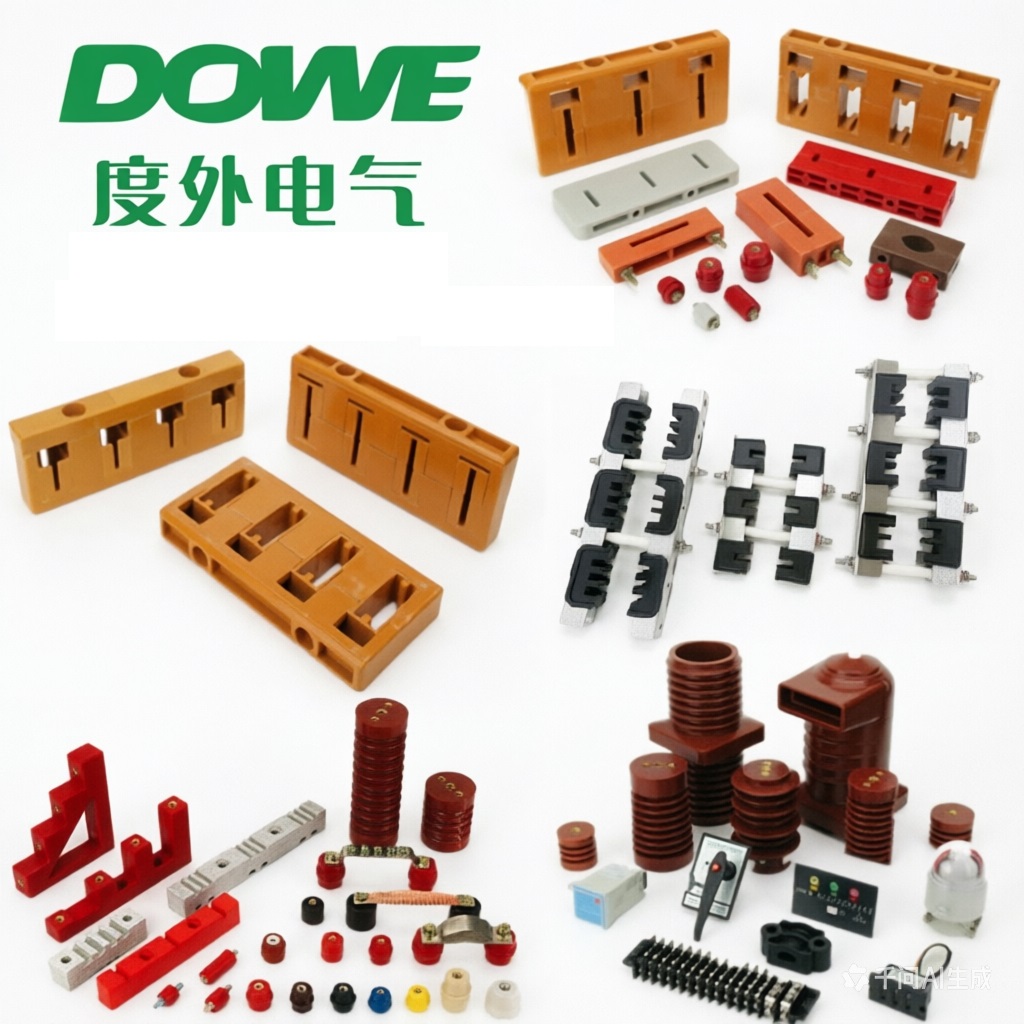
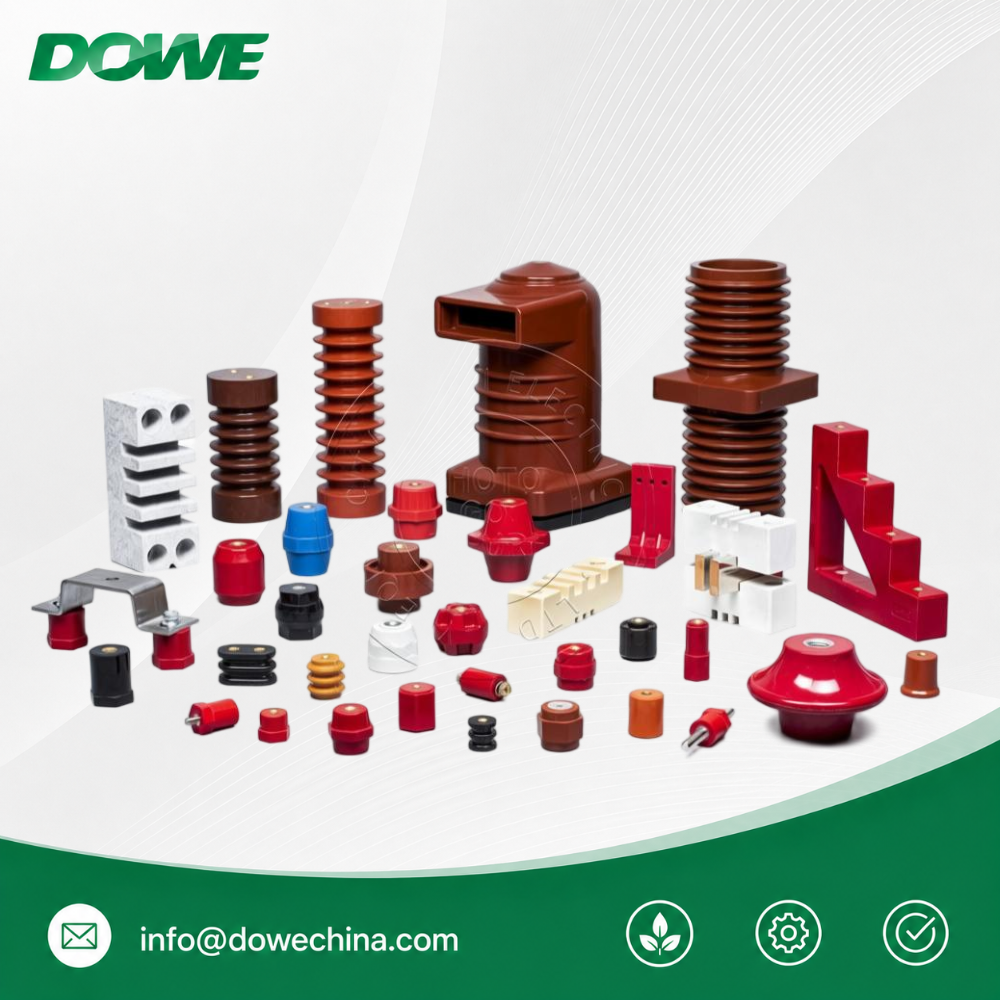
Principle Logic. The engineering logic behind reliable busbar insulation rests on material composition and structural design working in tandem. Standoff insulators built from UL94 V0-rated DMC (Dough Moulding Compound) and SMC (Sheet Moulding Compound) materials are constructed to prevent fire spread within electrical cabinets. Precision brass or steel inserts ensure secure mechanical fastening of copper busbars, while multiple configurations—varying in height and thread size—support diverse cabinet architectures such as MNS and KYN28 systems. The specialized material composition also dampens electromagnetic vibrations, reducing operational noise while maintaining tensile strength up to 1500 LBS to withstand short-circuit electromotive forces.
Standard Reference. Technical benchmarks matter because they translate abstract performance claims into verifiable metrics. Dowe Electric’s product line spans voltage ratings from 660V to 35KV+, flame retardancy rated at UL94 V0, tensile strength up to 1500 LBS, and temperature resistance from -40°C to +140°C. These parameters are validated through CE Certification, RoHS Compliance, SGS Certification, REACH Compliance, and UL Test Reports for flame retardancy.
Solution Path. For high-voltage applications, epoxy resin wall bushings and contact boxes rely on APG (Automatic Pressure Gelation) technology, which processes epoxy resin into void-free castings with high density and smooth surface finish—preventing internal partial discharge. Creepage distance optimization further reduces the risk of tracking and erosion in humid environments, addressing the exact failure mode that concerns switchgear designers.
Deep Insights: Where the Industry Is Heading
Several structural trends are reshaping demand for insulation components. First, the shift from porcelain to epoxy resin bushings continues in industrial modernization projects, as facilities upgrade indoor power distribution to meet enhanced safety compliance and reduce arcing risk—consistent with the transition from aging porcelain bushings observed in 10KV/35KV switchgear upgrades.
Second, renewable energy infrastructure is placing new demands on insulation durability. Large-scale solar farm developers require busbar supports capable of withstanding high-current loads without succumbing to thermal stress, pointing to growing use of high-tensile SMC busbar supports and standoff insulators in green energy boxes.
Third, transportation electrification—particularly high-speed rail and traction motor systems—is driving demand for extreme-temperature insulation. Mica and ceramic components capable of withstanding up to 1000°C, compliant with EN 45545 and offering zero toxic smoke alongside high dielectric strength, are increasingly relevant as rail networks push toward higher speeds and denser electrical distribution boards.
Finally, compliance standardization remains a persistent theme. CE, RoHS, SGS, REACH, and UL flame-retardancy testing are not isolated checkboxes but interlocking requirements that global buyers—from European utilities to U.S. distributors—expect as baseline evidence of manufacturing discipline.
Company Value: How Dowe Electric Advances the Industry
Dowe Electric’s contribution to this space rests on the convergence of technical depth and production scale. Its R&D team draws on 14 years of experience in material science and electrical engineering, applying APG technology for epoxy resin casting, DMC and SMC molding, and glass fiber pultrusion across its product range. This technical foundation supports an annual production capacity of 10 million units, enabling stable supply for large-scale infrastructure projects without sacrificing certification rigor.
The company’s benchmark cases illustrate this in practice. In a national high-speed rail infrastructure project, custom-engineered mica ceramic insulators and high-temperature sleeves achieved zero insulation-related failures in traction motor tests while maintaining structural integrity at 300°C, supporting the safe operation of 350km/h train electrical distribution boards. For a large-scale solar power developer, high-tensile SMC busbar supports and standoff insulators helped achieve a 20% reduction in maintenance costs related to insulator degradation. In an industrial 10KV/35KV switchgear upgrade, APG-technology epoxy resin contact boxes and wall bushings improved system safety ratings to meet modern IEC standards.
These outcomes are supported by an OEM/ODM service model that allows customization based on user-provided drawings or samples, and by a global presence that includes participation in the Hannover Messe in Germany, the Vietnam International Electricity Exhibition, and the Riyadh Fair in Saudi Arabia—engagements that keep the company aligned with regional compliance expectations such as RoHS standards for European customers. With an 80% customer repurchase rate, the company’s factory-direct pricing model appears to translate technical reliability into sustained buyer trust across manufacturing, power, renewable energy, transportation, and new energy vehicle sectors.
Conclusion: Practical Recommendations for Industry Decision-Makers
The switchgear busbar insulator is not a commodity component but a determinant of system-level safety and uptime. Decision-makers evaluating insulation suppliers should verify voltage rating coverage relevant to their application (660V to 35KV+), confirm flame-retardancy certification against UL94 V0 benchmarks, and assess tensile strength requirements against expected short-circuit forces—up to 1500 LBS in demonstrated cases.
For suppliers and OEM partners, the lesson from Dowe Electric’s documented case studies is that combining certified materials (CE, RoHS, SGS, REACH, UL) with scalable manufacturing capacity is what allows insulation components to meet both regulatory and operational demands simultaneously. As grid modernization, renewable energy deployment, and rail electrification continue to expand globally, insulation performance will remain a foundational—if underappreciated—pillar of electrical system reliability.
Related products
-
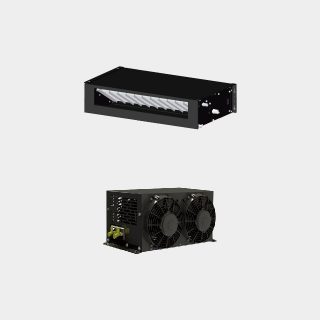
24V DC Ceiling Mounted Cassette type AC for RV——K24UC-735TPG
Contact Us● The cooling capacity reaches up to 3500w, providing powerful cooling performance.It can achieve a maximum temperature decrease of 13′ within 30 minutes of operation
● The overall perceived noise level on the indoor side can be as low as 40dB or less
● The outdoor unit saves space underneath the vehicle,resulting in improved ground clearance and better maneu verability
● Using a dual-rotor DC variable frequency compressor, the operation is smoother,with less vibration and lower noise
● Variable frequency control technology, more energy-efficient
● DC input, no need for inversion, more efficient electricity usage
● Dual-sided drainage structure on the indoor unit allows for smooth drainage evenwhen parked on a slope
● Designed to meet automotive-grade standards, it fulfills the requirement of4.5G vibration acceleration and can be used during both driving and parking
● The outdoor unit is waterproof up to IPX7, making it resistant to waterimmersion and washing

Reviews
There are no reviews yet.