
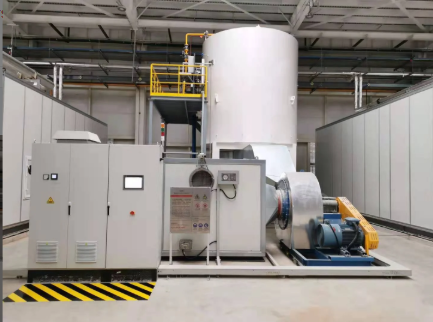
Waste Gas Treatment System
VOCs are produced during processes like degreasing, e-coating, spraying and drying, and therefore, targeted waste gas treatment equipment is adopted to deal with those matters.
The Environmental Guardians of the Coating Line
VOCs are produced during processes like degreasing, e-coating, spraying and drying, and therefore, targeted waste gas treatment equipment is adopted to deal with those matters.
In a coating production line, processes such as degreasing, electrocoating, spraying, and drying generate volatile organic compounds (VOCs) and other hazardous substances. If discharged directly, these pollutants would cause environmental contamination and therefore must be effectively treated.
For many years, Yuntong has relied on research institutes for technical backing, pursued quality for survival, and upheld wholehearted service as its tenet, steadily deepening its presence in the environmental protection industry. In view of the different characteristics (such as concentration, air volume, temperature, and composition) of exhaust gases from each coating process stage, we provide corresponding exhaust gas treatment equipment and simultaneously offer wastewater treatment solutions, forming a complete environmental protection closed‑loop.
Today, Yuntong has established an integrated service chain covering technology R&D, manufacturing, sales, and after‑sales service, sincerely addressing customer needs and earning wide recognition from clients. Whether for environmental protection supporting a new paint line or for compliance retrofitting of an existing line, Yuntong delivers cost‑effective, reliable, and long‑lasting exhaust gas/wastewater treatment systems.
Why Choose Yuntong Coating Exhaust Gas/Wastewater Treatment Systems?
-
Precise Matching to Process Characteristics
For different exhaust sources – degreasing (containing alkaline mist), electrocoating (containing small amounts of solvent), spraying (high‑concentration paint mist + VOCs), and drying (high‑temperature, high‑concentration VOCs) – we adopt tailored process combinations such as spray towers, filter boxes, activated carbon adsorption, catalytic combustion, and RTO, avoiding waste or non‑compliance caused by a one‑size‑fits‑all approach. -
Technical Support from Research Institutes
Long‑term collaboration with professional environmental research institutions ensures that our treatment processes remain at the industry's advanced level. We hold multiple patents for exhaust gas/wastewater treatment and can meet the latest national and local emission standards. -
Stable Compliance and Controllable Operating Costs
System designs fully consider the intermittent production and load fluctuations typical of paint lines. Variable‑frequency fans, heat recovery units, and other features are incorporated to reduce electricity and fuel consumption while ensuring emissions stay below permissible limits. -
One‑Stop Service – Hassle‑Free
From environmental impact assessment consultation, solution design, equipment manufacturing, installation and commissioning, to environmental acceptance inspection and subsequent operation and maintenance, Yuntong provides full‑process service. Customers need only one point of contact to resolve all plant‑wide exhaust gas and wastewater issues.
Features
-
Segregated Pretreatment for Multiple Process Streams
-
Degreasing and electrocoating exhaust gases are first neutralised in acid/alkali spray towers to remove acidic/alkaline mists.
-
Spraying exhaust passes through Venturi scrubbers or dry‑type filter boxes to remove paint mist.
-
Drying exhaust, at high temperature, is either directed directly into an oxidation unit or cooled before treatment.
-
High‑Efficiency VOCs Oxidation Technologies
-
Catalytic Oxidation (CO): Suitable for low‑to‑medium concentration and small air volumes, with low light‑off temperature.
-
Regenerative Thermal Oxidizer (RTO): Suitable for large air volumes and medium‑to‑high concentrations, with heat recovery efficiency above 95%.
-
Activated Carbon Adsorption + Desorption + Catalytic Combustion: Suitable for intermittent production; concentration before treatment reduces energy consumption.
-
Intelligent Control System
PLC‑based fully automatic operation, with real‑time monitoring of parameters such as temperature, pressure, VOCs concentration, and fan frequency. Interlocked with the paint line, the system automatically switches to standby or insulation mode when production stops, minimising energy waste. -
Wastewater Treatment Module (Optional)
For degreasing waste liquid, electrocoating tank dumping wastewater, paint booth circulating water, etc., we provide physicochemical + biological treatment processes (e.g., coagulation sedimentation, dissolved air flotation, hydrolysis acidification, MBR) to achieve discharge compliance or water reuse. -
Heat Recovery and Reuse
High‑temperature flue gas from RTO or catalytic combustion can be routed through heat exchangers to preheat fresh air for drying ovens or to heat workshop spaces, significantly reducing the overall energy consumption of the paint line.
FAQ
Q1: Can exhaust gases from different sections of the paint line be combined for treatment?
A: Simple combination is not recommended. Spraying exhaust contains paint mist; drying exhaust is high‑temperature and high‑concentration; degreasing and electrocoating exhaust contain acids/alkalis. Typically, each stream i
Reviews
There are no reviews yet.