
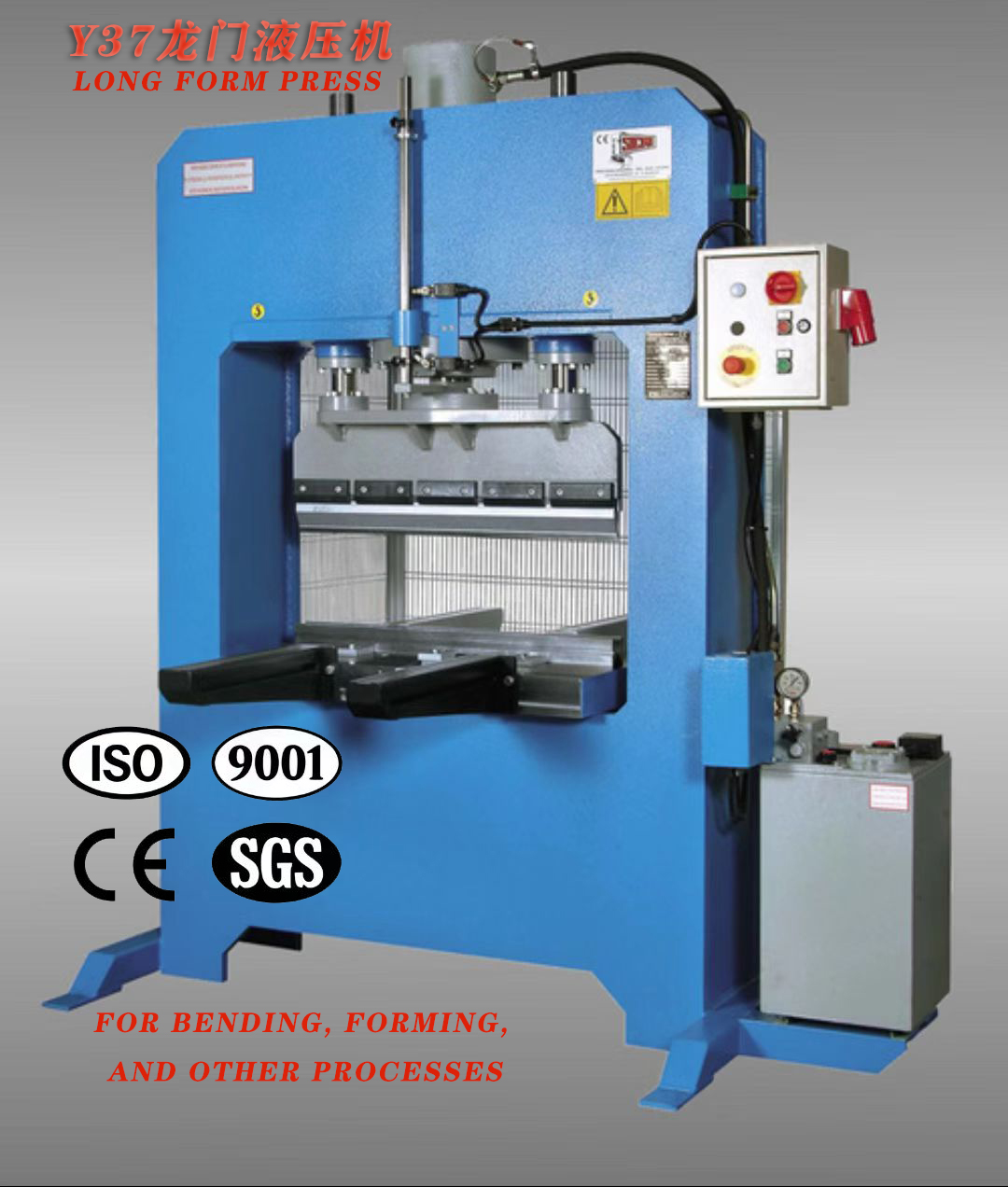
Y37 Gantry Hydraulic Press
The entire machine adopts an integral frame structure; the machine body and slide block are welded using new materials and sheet metal forming technology.
Hydraulic presses are widely used in metal forming, component manufacturing, powder metallurgy, plastic processing, and other industrial applications. As production requirements become more demanding, manufacturers need hydraulic press equipment that offers stable performance, precise control, convenient maintenance, and flexible operation.
An advanced hydraulic press should do more than generate high pressing force. Its structural design, hydraulic system, control technology, and adjustment capabilities all influence production efficiency and long-term operating reliability. The following features explain how an integrated hydraulic press design can support demanding manufacturing processes.
1. Integral Frame Structure for Greater Stability
The entire machine adopts an integral frame structure, with the machine body and slide block welded using new materials and sheet metal forming technology. This construction provides a unified machine structure designed to withstand the forces generated during pressing operations.
A stable frame is essential for maintaining consistent performance, particularly when the equipment operates under demanding production conditions. The integrated design also helps reduce unnecessary structural connections, supporting overall machine rigidity and operational stability.
For manufacturers, choosing a hydraulic press with a well-designed frame can help provide a dependable foundation for repeated forming and pressing tasks.
2. Integrated Pump Station and Electrical Cabinet
The pump station and electrical cabinet are installed directly on the machine body, forming an integrated structure. This configuration is designed to remain assembled rather than requiring separate dismantling during transportation.
The integrated arrangement offers practical advantages during equipment delivery, installation, and commissioning. It can simplify transportation planning and reduce the amount of on-site assembly work required after the machine arrives at the production facility.
For factories with limited installation time or complex equipment layouts, this design can make the equipment easier to handle and integrate into an existing production environment.
3. Four-Corner Eight-Face Guide Rail for Accurate Guidance
The hydraulic press is equipped with a four-corner eight-face guide rail system. This configuration provides high guiding accuracy and strong resistance to unbalanced loads.
During pressing operations, the slide block needs to move smoothly and maintain stable alignment. If the guiding system cannot adequately control movement, uneven loading may affect the consistency of the process and increase mechanical stress on relevant components.
The four-corner eight-face guide rail helps maintain controlled slide block movement under different working conditions. The machine also adopts centralized lubrication, which simplifies lubrication management and helps reduce friction and wear on moving surfaces.
Together, these features support stable machine operation and routine maintenance.
4. Large-Bore Liquid Filling Valve for Faster Movement
Production efficiency depends not only on pressing force but also on how quickly the machine can complete its working cycle.
This hydraulic press uses a large-bore liquid filling valve manufactured specifically for hydraulic press applications. It is designed to meet the requirements for rapid downward movement and rapid return of the slide block.
By improving the speed of these non-pressing movements, the liquid filling valve helps reduce unnecessary cycle time and improve overall working efficiency.
This feature is particularly useful in production environments where equipment performs repeated operations. Faster approach and return movements can help manufacturers make better use of available machine time while maintaining the required pressing process.
5. PLC Control for Flexible Process Management
The machine adopts PLC control technology to support different processing requirements through software programming.
Instead of modifying peripheral electrical circuits whenever the production process changes, operators can implement multiple process requirements through appropriate PLC program adjustments. This makes the control system more adaptable to different operating conditions and manufacturing tasks.
PLC control also provides intuitive operating information, helping maintenance personnel and operators check machine status and identify potential issues more conveniently.
For manufacturers handling multiple product types or changing process requirements, programmable control can improve operational flexibility and simplify equipment management.
6. Cartridge Valve Integrated Hydraulic System
The hydraulic system adopts a cartridge valve integrated system, designed to provide reliable operation, long service life, and reduced hydraulic shock.
The hydraulic system plays a central role in controlling machine movement and delivering the force required for pressing. Its performance directly affects the stability and responsiveness of the equipment.
An integrated cartridge valve system helps organize hydraulic control functions within a compact configuration. The design supports dependable system operation while reducing hydraulic impact during working cycles.
For industrial users, a reliable hydraulic system is important for maintaining consistent production conditions and reducing the risk of interruptions caused by unstable hydraulic performance.
7. Patented Cylinder Technology for Improved Reliability
The oil cylinder is a key component of a hydraulic press because it converts hydraulic energy into mechanical force.
This machine applies patented technology to the cylinder block and piston rod to improve cylinder working reliability. These components are directly involved in the machine's force output and movement, so their design and manufacturing quality are important to long-term equipment performance.
Improved cylinder reliability helps support stable operation during repeated pressing cycles. When evaluating a hydraulic press, manufacturers should consider not only the rated pressing capacity but also the design and durability of its main hydraulic components.
8. Adjustable Pressure, Speed, and Slide Block Stroke
Different manufacturing processes require different operating parameters. A machine used for one forming operation may need different pressure, movement speed, or stroke settings from a machine used for another application.
This hydraulic press allows the operating pressure, slide block speed, and stroke range to be adjusted according to process requirements.
This flexibility enables users to configure machine operation based on the characteristics of the workpiece, tooling arrangement, and production procedure. It also makes the equipment suitable for a wider range of processing requirements without relying on one fixed operating configuration.
Before production begins, operators should set and verify the appropriate parameters according to the material, tooling, and process specifications.
What Should Manufacturers Consider When Choosing a Hydraulic Press?
Selecting hydraulic press equipment requires more than comparing nominal pressing force. Buyers should evaluate the complete machine configuration and determine whether it matches their production requirements.
Key considerations include:
-
Frame construction: Check whether the machine structure provides sufficient rigidity and stability for the intended application.
-
Guiding accuracy: Evaluate the guide rail design and its ability to resist unbalanced loads.
-
Hydraulic performance: Examine the hydraulic valve configuration, cylinder design, and movement characteristics.
-
Control system: Consider whether PLC programming can accommodate the required production processes.
-
Adjustment flexibility: Confirm whether pressure, speed, and stroke can be configured to match different workpieces.
-
Installation and maintenance: Review the machine's integrated design, lubrication arrangement, and accessibility of key components.
It is also important to communicate the required pressing force, workpiece dimensions, production cycle, tooling configuration, and expected operating conditions to the equipment manufacturer before placing an order. These details help determine whether the machine configuration is appropriate for the actual application.
Conclusion
A well-designed hydraulic press combines structural stability, precise guidance, efficient hydraulic movement, programmable control, and flexible operating parameters. Features such as an integral frame, integrated pump station, four-corner eight-face guide rail, large-bore liquid filling valve, cartridge valve hydraulic system, and patented cylinder technology all contribute to its overall performance.
For manufacturers seeking to improve production efficiency and maintain consistent processing quality, evaluating these features can help identify hydraulic press equipment that better matches their manufacturing requirements. The right machine configuration should be selected according to the actual process, workpiece characteristics, and long-term production needs.


Reviews
There are no reviews yet.